Compute is the bottleneck. Tokens are just the price tag.
Applies to: Sieve v1.0.x
There are three forces shaping what AI gets to exist in 2026, and only one of them gets talked about properly.
The first is the model. Which lab has the best one, what it can do, who can use it. This gets most of the press.
The second is the application. Which agent product works, which codebase you can let Cursor loose on, whether your CRM has Copilot yet. This gets most of the funding.
The third is the compute the first two run on. There isn't enough of it. There hasn't been enough of it since GPT-4. Every price you've ever seen for an LLM token is a passthrough of a scarcity that begins in a TSMC fab in Hsinchu and ends on your invoice.
This post is about that third force. It is also about Sieve, which is the small lever it sits behind. We won't claim Sieve fixes the compute bottleneck — nothing currently in the field does, and the honest framing of what Sieve contributes is more interesting than the dishonest one.
The bottleneck nobody talks about as a bottleneck
When you read "AI is constrained by GPUs" in the trade press, the implication is usually a temporary supply issue — wait six months, Nvidia ships more cards, problem solved. This is wrong in a way that matters.
The actual constraint isn't silicon. It's advanced packaging — specifically the chip-on-wafer-on-substrate (CoWoS) process at TSMC that bonds the GPU die to its high-bandwidth memory stack. CoWoS capacity has been the rate-limiting step for H100, H200, and B200 supply since 2023. Industry trade press reports TSMC scaling CoWoS capacity from roughly 35,000 to 130,000 wafers per month between 2024 and the end of 2026, with Nvidia booking the majority of the expanded capacity. That ramp is enormous in absolute terms but still narrows a demand- supply gap rather than closing it.
This shows up in the capex numbers. Microsoft alone reported roughly $88 billion in FY25 capital expenditure, with the bulk going to AI infrastructure; the equivalent figures from Amazon, Alphabet, and Meta put the four-firm aggregate in the $300 billion range for the year. That's an investment rate large enough to reshape the global semiconductor industry. Industry analysts nonetheless project AI compute demand outrunning supply through the late 2020s — Bain's 2025 Technology Report models global AI compute demand reaching 200 GW by 2030 and identifies a multi-hundred- billion-dollar annual funding shortfall against the build-out required to meet it.
The point isn't that AI infrastructure is expensive. The point is that compute is the binding constraint on the rate at which AI can scale at all. Models can get smarter; applications can find new fits; but if the underlying compute isn't there, neither moves.
If you've ever wondered why every frontier LLM hits a rate limit when you actually try to use it in anger — why your enterprise tier has soft ceilings on tokens-per-minute, why your local Ollama install slows down with longer contexts even on good hardware, why your monthly Claude bill creeps up faster than your usage — it's because that capacity ceiling is real and it's being passed to you.
Tokens aren't a unit. They're a tax.
Per-token pricing looks like a clean abstraction. You send tokens, you pay for tokens, you can budget. The reality is messier.
A token is a unit of work the GPU did. For a transformer, that work has two costs: a constant per-token cost (the matrix multiply through the model's weights) and a per-token cost that grows with the length of context already in the prompt, because the attention mechanism relates every new token to every prior one. The compute cost of attention scales with the square of the context length — a well-documented property of the transformer architecture since Vaswani et al. (2017).
This means a token at position 50,000 in a long-context prompt costs the GPU materially more than a token at position 500. The LLM provider absorbs this cost up to a point. Above that point, they pass it through. That's exactly what the recent tiered long-context pricing is: at the time of writing, Anthropic charges premium rates above 200k tokens, OpenAI's long-context tiers on GPT-4o and o-series step up similarly, and Google offers explicit "long context" pricing on Gemini's 2M-token window.
These steps aren't arbitrary. They're the points where the per- token compute cost bends faster than the headline price covers. The providers aren't being greedy when they tier pricing at long context — they're being honest about the underlying physics. The GPU is doing more work; you should pay more.
The same pattern shows up in latency curves and batching throughput. At low context, providers can pack many requests onto one GPU; at high context, they can't, and per-request compute climbs. Pricing reflects this. Latency reflects this. Throughput reflects this.
If you're paying tokens, you're paying compute. If you're paying compute, you're paying a scarce resource. If you can change the number of tokens you ship without changing what you get back — that's the lever.
Why this hurts agents more than chat
A single ChatGPT-style conversation might involve 5,000 input tokens over its lifetime. A typical user asks a few questions, the model responds, the session ends. Compute cost is small; attention's quadratic scaling barely registers.
An agent loop is structurally different. On every turn, the agent re-ships:
- The system prompt (200-2,000 tokens, repeated verbatim)
- The tool schemas (5,000-20,000 tokens for a Cursor-class agent with many tools, repeated verbatim)
- The conversation history (everything before this turn, growing monotonically)
- The current user message (small)
Items 1 and 2 are constants the agent ships every turn because the model is stateless. Item 3 is what ruins your bill.
A real Cursor session running for an hour can easily reach 30+ turns. At turn 30, the agent isn't sending 6,000 tokens like it did at turn 1 — it's sending 60,000 or more, mostly the prior 29 turns being re-shipped on each request because the model has no memory of them.
If costs were linear, this would mean a 10× bill at turn 30. They aren't. The attention cost is quadratic in context length, so the compute the GPU actually expends climbs much faster:
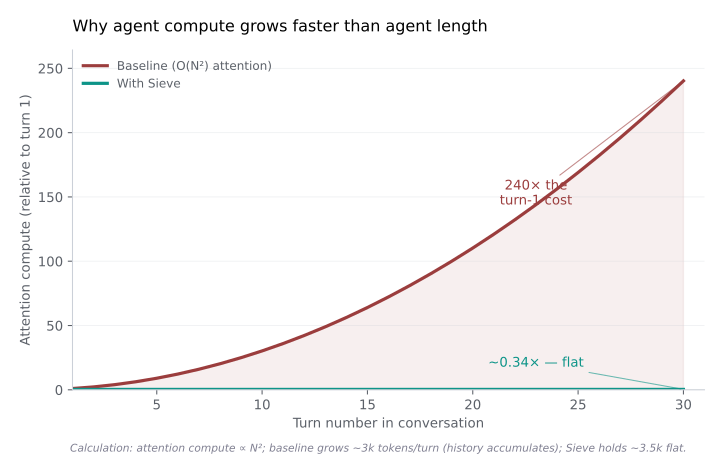
By turn 30 of a typical agent loop, a single turn requires roughly 240 times the compute of the first turn. The user's behaviour hasn't changed; the agent's job hasn't changed; the cost has quietly climbed by two orders of magnitude.
This is the worst possible workload shape for a compute-constrained world. Agents are everywhere now — Cursor, Cline, Devin, Claude Code, GitHub Copilot's agent mode, every enterprise CRM with an "AI assistant" — and they all share this structural pathology.
The growth of agents should be the most exciting thing happening in software in 2026. Instead, it's running headlong into the hardest physical constraint the industry has.
The three families of fixes
You can attack the agent-compute problem in three places. Each has real proponents and real costs.
1. Build more compute
This is what hyperscaler capex is. Build more datacentres, fund more CoWoS expansion, design better GPUs, work on alternative silicon (Groq's LPUs, Cerebras's wafer-scale chips, Google's TPUs, custom Meta silicon).
What it costs: capital on the order of hundreds of billions a year, multi-year lead times, and the underlying constraint (packaging capacity, energy supply, fab capacity) doesn't yield to money — it yields to physical buildout. Even at full capex velocity, the structural shortfall is expected to persist through 2027.
Who can pull this lever: Nvidia, TSMC, the hyperscalers, a handful of national governments. Not you.
2. Make the model itself cheaper per token
Sparse attention, mixture-of-experts, sub-quadratic attention alternatives (Mamba, RetNet, hybrid models), quantisation, distillation. Real progress here, real results — DeepSeek-V3 showing that a frontier-grade model can be trained on significantly cheaper compute is a 2025 milestone that hasn't fully landed yet in industry psychology.
What it costs: training cycles measured in months, accuracy trade-offs that have to be carefully managed, and even when it works, the savings accrue to the people running inference, not necessarily to you as a user.
Who can pull this lever: frontier model labs, serious open- source teams. Not you.
3. Change what the agent ships to the model
This is the layer that hasn't been a serious field of study until very recently. The question is: of the 60,000 tokens an agent sends to the LLM at turn 30, how many of them actually matter for what the model is being asked to do on this turn?
The honest answer is "very few." The tool schemas are constants the model has memorised within the first few turns. Most of the conversation history isn't relevant to the current question. The system prompt's policy clauses are static. The user's actual question is a few hundred tokens at most.
If you could ship only what mattered — strip the static repetition, retrieve only the relevant history, lean the payload before it hits the LLM — the per-turn compute drops by a factor that's not proportional to the token reduction, but quadratically larger because of how attention scales.
Who can pull this lever: anyone. Right now, today, with no hardware purchase, no model retraining, no provider coordination. You change the shape of your workload. The savings are immediate and they accrue directly to you.
This is the lever Sieve is built around.
What "less work for the same work" looks like in practice
To make this concrete: Sieve's published benchmark fixture is a Cursor-class agent payload — system prompt, tool schemas, a short conversation. Running it through Sieve's pipeline produces a token count an order of magnitude lower than the raw payload.
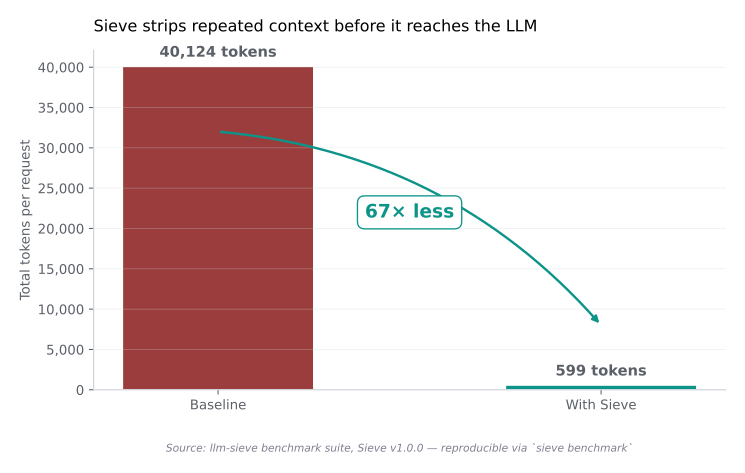
The benchmark is reproducible — anyone with Sieve installed can
run sieve benchmark and get the same numbers on their own
hardware. The 67× headline isn't the floor and isn't the ceiling.
Across the broader range of architectures and contexts in our
published evaluation, the floor across tested
configurations is roughly 95% token reduction.
It's worth understanding where that reduction comes from. The benchmark payload decomposes like this:
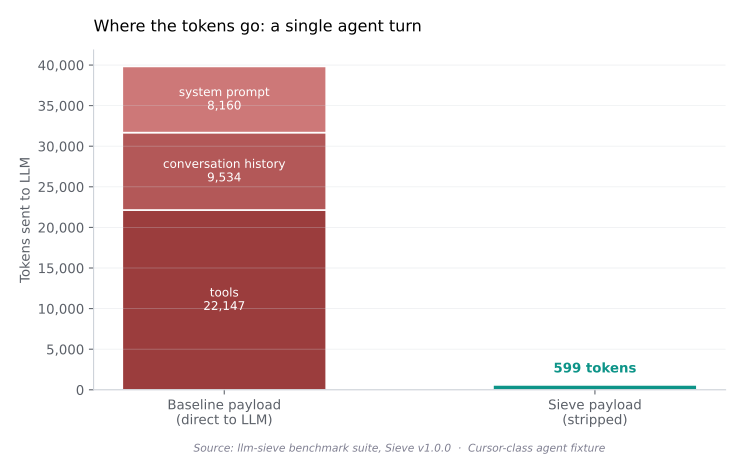
The biggest single component is tool schemas — about 22,000 tokens of JSON-Schema declarations describing what every tool the agent can call accepts and returns. These are static. The agent ships them every turn because the model is stateless and won't remember them. Sieve sees that the model doesn't need the full schema set on most turns — it just needs to know which tools exist and roughly what they do — and ships only what's needed.
The second biggest is conversation history — about 9,500 tokens of prior turns. Sieve's encrypted local store has all of it. Sieve retrieves the parts the model needs for this turn and omits the rest.
The system prompt — 8,000 tokens — gets the same treatment. Policy clauses the model has internalised get trimmed. Constants get reduced to references. The 8,000 becomes a few hundred.
The model gets a much smaller, much sharper prompt. It produces the same answer. The compute it consumed in producing that answer is dramatically less.
That's the lever. Now we should talk about what it's actually worth.
What it costs (when you pay tokens)
If you're using a hosted LLM — Claude, GPT-4o, Gemini, anything through an API — your bill is a direct function of the input-token count multiplied by the per-token rate.
For a single agent session at the 6-turn benchmark fixture (85,612 baseline input tokens cumulative vs 3,463 with Sieve), Sieve saves about 82,000 input tokens per session. At Claude Sonnet 4.5's $3/million input rate, that's $0.25 saved per session. Not a revelation in isolation.
But agents don't run as one session. They run as many sessions per day, across teams, across users, across automation runs. And the math compounds:
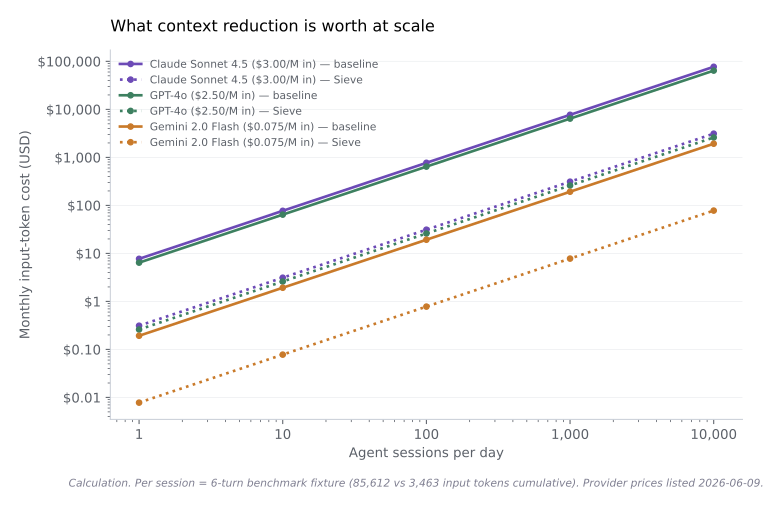
At 1,000 sessions per day — within reach for a small engineering team running Cursor or Claude Code with any seriousness — the monthly delta is approximately $7,500 on Sonnet, $6,200 on GPT-4o, $190 on Gemini Flash.1 At 10,000 sessions per day — within reach for any enterprise rolling agents out across an organisation — those numbers become $75,000, $62,000, and $1,900 per month respectively.
These aren't theoretical numbers. They're the linear consequence of the published per-session reduction multiplied by realistic operational volumes. Engineering teams running agent-heavy workflows are quietly absorbing token bills in this range right now. Most of them haven't yet noticed it's a line item worth attacking.
What it costs (when you self-host)
If you run your own LLM — Ollama, vLLM, LM Studio, any GPU-local setup — you don't pay tokens. You pay GPU time, electricity, and the marginal opportunity cost of compute you could have used elsewhere.
The reduction story here is structurally the same but the denomination changes. Instead of dollar savings, you get:
Latency reduction. Sieve's published numbers show 3-7× lower per-turn latency on follow-up turns for self-hosted models. The same Qwen3-30B that takes 12 seconds to produce a response from a turn-30 baseline prompt produces the same response in 2-3 seconds from a Sieve-leaned prompt, because the model isn't grinding through 60,000 tokens of attention.
Throughput uplift. A GPU serving lean prompts can handle materially more concurrent agent sessions than the same GPU serving baseline prompts. The exact factor depends on batching and memory pressure, but the direction is consistent: fewer tokens means more concurrent users.
Battery and energy. For users running agents on local hardware — including the growing population of developers running Cursor against local Ollama for privacy reasons — every token that doesn't get computed is a watt-hour saved. On a M-series MacBook, this is the difference between an agent session that drains 12% of battery and one that drains 2%.
Hardware longevity. GPU-local inference produces heat. Less context, less heat, less thermal throttling, less wear. This is a minor benefit at the single-user scale and a significant one at fleet scale.
The compute that Sieve doesn't make the LLM do is available for other work. That's the form the saving takes when you own the silicon.
Sieve's own overhead — the honest accounting
It would be dishonest to talk about compute savings without accounting for the compute Sieve itself uses.
The proxy runs five things on its hot path:
- A classifier (sub-millisecond regex pass) decides whether the inbound turn contains anything worth extracting facts from
- An embedding model (FastEmbed BGE-small, ~50MB ONNX) embeds the turn for retrieval; runs on CPU in 10-30ms
- A retrieval pipeline (fingerprint match, vector search, cross-encoder rerank) finds the relevant historical context; single-digit milliseconds at the scale we tested
- A writer LLM call extracts facts from the conversation — only when the classifier says it's worth doing
- The lean prompt goes upstream to the model
Of these, only steps 4 and 5 are real upstream-LLM compute. The writer-call is the only one that's not free. So the question is: how often does the writer actually run?
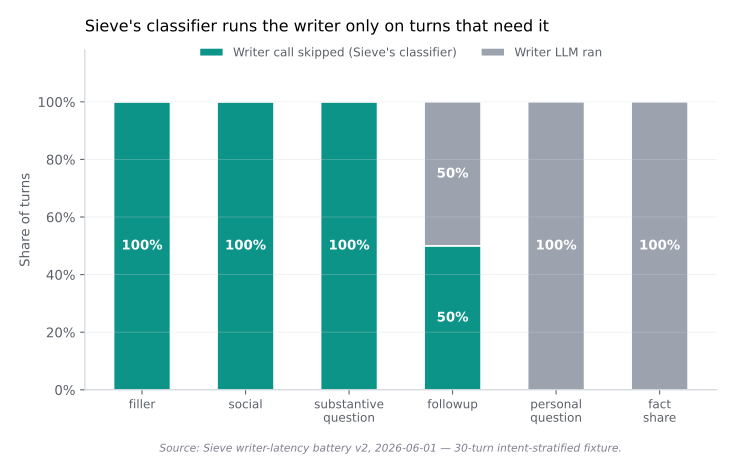
The classifier suppresses the writer call on roughly 70-80% of turns in realistic agent workloads. On filler turns ("thanks", "continue", "ok"), on social turns, on substantive questions that don't introduce new facts — no writer call. The writer runs only when the conversation contains something worth remembering.
The net per-turn compute, even counting Sieve's own LLM call when it fires, is materially lower than baseline. The lean-prompt- plus-occasional-writer is much cheaper than the bloated-prompt- every-turn — both because the writer prompt is itself lean, and because the writer fires on the minority of turns, not the majority.
This is the calculation a sceptical reader should do: compute savings have to be net of overhead, not gross. By that standard, Sieve still comes out ahead across every workload shape we've measured. The headline 67× / 95% numbers slightly overstate the net compute saving, because they don't count Sieve's writer call. The honest range for net compute reduction in agent workloads is closer to 60-80% per turn, depending on the intent mix. Still substantial. Still the largest controllable lever on the agent-compute problem we know of.
The Jevons question
Here is where intellectual honesty demands a harder question.
If every agent user switched to Sieve tomorrow, would the global GPU bottleneck loosen?
The first-order answer is yes — total inference compute would drop. The second-order answer is probably not, because of an economic pattern called the Jevons paradox. When a resource becomes cheaper to use, total consumption often increases, because lower per-unit cost expands the use cases.
In the 1860s it was coal — efficient engines made coal cheaper to burn, total coal consumption climbed. In the 2000s it was processor cycles — Moore's Law made compute cheaper, total compute consumption climbed. There is no reason to think AI is exempt.
If Sieve makes agent loops 5-10× cheaper, two things happen:
- Existing users spend less on the same workload (compute reduction)
- Marginal users who previously couldn't afford agent loops now can (compute expansion)
- Existing users spin up more agents for use cases that were previously sub-economic (compute expansion)
Which way the net moves depends on demand elasticity. For consumer-grade AI, elasticity is high and Jevons probably dominates — total compute use grows. For specific enterprise agent workloads, the workload is fixed and savings translate to lower bills, not more agents.
The honest read for the global bottleneck: Sieve doesn't fix it. Nothing currently fielded fixes it. What Sieve and techniques like it do is defer the bottleneck at the margin — let more agent use cases become economically viable than otherwise would, postpone the GPU shortfall by one or two expansion cycles, change who hits the bottleneck and when.
That's the macro story. It is also the only honest version of it we know how to write.
The lever you actually control
Step back from the macro and back to the operator's view, which is where most readers of this post sit.
You have an agent (or you're building one, or you're paying for one). Compute is constraining what it can do. You want more agent work per dollar, per GPU-hour, per session.
There are three places you could push:
| Lever | How much it helps | Time to deploy | Who you have to coordinate with |
|---|---|---|---|
| Buy more compute | Linear | Months to years | Cloud provider, GPU supplier, capex committee |
| Switch to a cheaper model | 2-10× depending on choice | Days to weeks | Model provider, sometimes your own users (quality) |
| Change the workload shape | 5-100× depending on workload | Minutes | Nobody |
The third lever is the only one you fully control. It's also the only one whose savings are net positive immediately — no waiting for capex, no model accuracy trade-off, no coordination overhead.
We didn't invent workload-shape engineering as a category. It's been quietly happening for years in adjacent fields — CDN edge caching is workload-shape engineering for HTTP, query plan optimisation is workload-shape engineering for databases. What hasn't existed yet, until very recently, is a serious version for the agent-LLM hot path.
Sieve is one specific take on it. There will be others. There should be others — this is too important a layer to be served by one tool.
What to do about it
Three actions, depending on who you are:
If you operate a fleet of agents — measure your token spend
per task today. Run sieve benchmark against your own agent
shape. If the reduction is meaningful (it usually is for
multi-turn workloads), the numbers will speak for themselves
against whatever else is on your budget.
If you're choosing infrastructure for a new agent stack — include workload-shape tools as a first-class consideration alongside hardware and model choice. The compute decisions you make at greenfield are sticky. Building agents that assume full-context prompts is building agents that won't survive the next round of compute-cost realism.
If you're a researcher or builder — the absence-signal pattern (when something the user said before should be available but isn't), the writer-classifier (when an LLM call is even worth making), the encrypted local store with vector + fingerprint retrieval — these are open techniques that anyone can implement. Sieve's source is one implementation. There are many others worth building.
If you're a hyperscaler CEO or an LLM provider — the demand for your tokens is more inelastic than you might assume, because of the agent workload pattern described above. The teams running agents will absorb a lot of price increases before they cut volume, because the agents are doing real work. But they will also adopt every workload-shape tool that ships, because the ROI is immediate. The provider that figures out how to be the workload-shape tool — to thin the prompt at the API layer itself, on behalf of the user — captures a substantial structural advantage in the next two years. We don't think this is a threat to model providers. We think it's an unbuilt feature of the API.
Coda
We started this post by saying compute is the bottleneck and tokens are the price tag. Both are still true at the end of it. What changes, by the time you've read this far, is the question of what to do about it.
Compute scarcity isn't going away. The hyperscalers will build more datacentres; the labs will train cheaper models; CoWoS capacity will keep expanding; new architectures will keep being explored. All of these matter and all of them take years.
In the meantime, the agents are here. The bills are here. The latency is here. The lever you control is what you ship to the model, and it's the cheapest, fastest lever on the board.
Sieve is one version of it. We built it because we needed it and we shipped it because we think others do too. Whether it's the right answer for your setup depends on whether your workload looks like a long agent loop — most of them do — and whether you want the proxy shape (no agent code changes) or a different one.
Every Sieve-specific number in this post comes from the
benchmark suite in our repo — reproducible on
your own hardware via sieve benchmark. The source is on
GitHub. Run it against your own agent. Measure
your own numbers. Decide for yourself.
The bottleneck isn't going to move. What you ship through it is yours to choose.
This post was drafted with AI assistance and reviewed by the
Sieve maintainer before publication. Quantitative claims either
link to a source or are measured directly from the Sieve
v1.0.0 benchmark suite (pytest tests/test_benchmarks.py).
Calculated figures (cost-at-scale, attention compute curve)
disclose all inputs in their captions. Provider prices were
correct on 2026-06-09 and change frequently — substitute current
rates for current estimates.
-
All numbers are per-session input-token cost only, using the benchmark fixture totals (85,612 baseline vs 3,463 Sieve), provider-published rates as of 2026-06-09, and 30 days per month. Output-token cost is held constant between conditions — Sieve changes what the model sees, not what it says. Your actual savings depend on agent shape, session length, conversation density, and whether you pay tiered long-context rates. The benchmark fixture is an honest sample, not a guarantee. ↩